
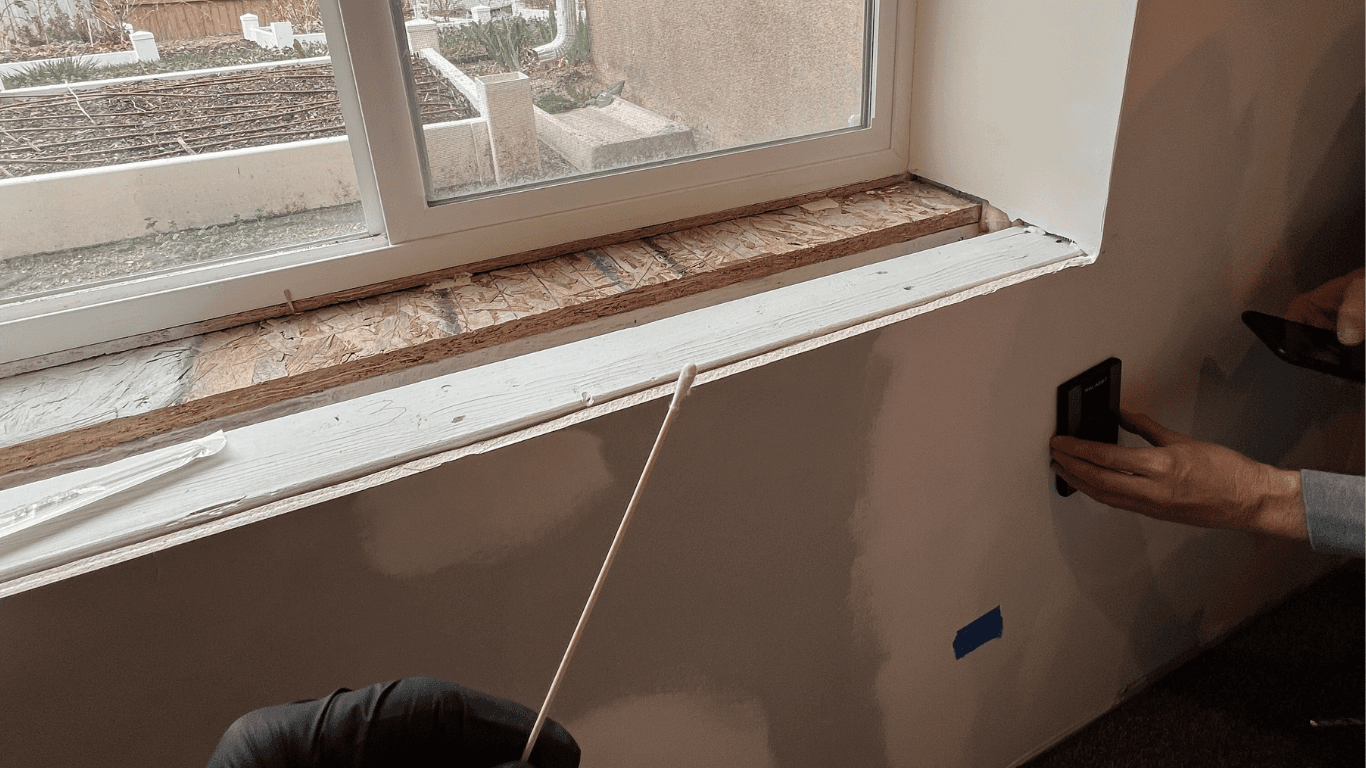
You Just Had Mold Removed. Here's Why You're Not Done Yet.
You Just Had Mold Removed. Here's Why You're Not Done Yet.
Mold remediation removes the visible problem. Post-remediation clearance proves it's actually gone — and in Utah's tricky climate, that distinction matters more than most homeowners realize.
The crew packed up. The affected drywall is gone. The space smells clean and looks better than it has in years. It's tempting to close the door on the whole ordeal and move on.
But here's what most homeowners in Salt Lake County, Utah County, and Davis County don't know: the way mold looks after remediation tells you almost nothing about whether it's truly been resolved.
Mold spores are microscopic. They travel through air. They hide in wall cavities, insulation, and HVAC ductwork. And in Utah — where seasonal snowmelt, ice dams, swamp coolers, and tightly sealed energy-efficient homes create moisture conditions that are easy to miss — they have plenty of places to keep growing, completely out of sight.
This is exactly why post-remediation clearance (also called post-remediation verification, or PRV) exists. It's not another round of cleanup. It's the independent confirmation that the work done was actually enough.
What is post-remediation clearance?
Post-remediation clearance is a structured evaluation of your home after mold remediation is complete. It uses inspection, moisture measurement, and sometimes lab testing to answer one essential question:
Is your indoor environment back to normal — or is contamination still present?
It is not cleaning. It is not remediation. It's verification — and it should always be done by someone independent from the company that did the remediation work. More on that in a moment.
Why Utah homes are especially vulnerable
Utah's dry climate creates a false sense of security. Homeowners often assume that because the air feels arid, mold isn't a serious concern. In reality, mold only needs localized moisture — and Utah homes have plenty of places where it hides:
Attic damage from ice dams and snowmelt seeping under rooflines
Basement and foundation seepage during spring runoff
Evaporative coolers (swamp coolers) introducing steady indoor humidity
Poorly ventilated bathrooms and laundry rooms
HVAC systems that recirculate contaminated air throughout the home
Homes along the Wasatch Front — especially those built with tightly sealed envelopes for energy efficiency — can trap contaminants indoors in ways that older, leakier homes don't. That's a genuine risk factor, not a talking point.
The biggest misconception after remediation
The most dangerous assumption a homeowner can make after mold removal is this: it looks clean, so it must be clean.
Residual spores can remain inside wall cavities, in porous insulation, on surfaces that were disturbed during remediation, and throughout ductwork — none of which are visible to the naked eye. Without a proper clearance inspection, there's simply no way to know whether the problem was fully resolved or just made less obvious.
If the moisture source that caused the mold wasn't fixed, the mold will come back. It's not a possibility — it's a certainty.
What a proper clearance inspection should include
A thorough post-remediation clearance in Utah goes well beyond a quick walkthrough. Here's what it should cover:
Visual inspection — Confirming no visible dust, debris, or residue remains; verifying that remediation areas were properly cleaned with no signs of ongoing growth.
Moisture assessment — Measuring moisture levels in drywall, wood, and flooring; identifying hidden damp areas; and confirming that the original leak or intrusion source was actually corrected. This is especially critical in Utah homes where temperature swings between seasons can cause materials to behave unpredictably.
Environmental testing (when warranted) — Air sampling to evaluate current spore levels and surface or cavity samples in targeted areas, compared against normal indoor/outdoor baselines.
HVAC and airflow evaluation — Assessing whether the HVAC system was impacted, how air moves between rooms and levels, and whether ventilation is adequate to prevent future buildup.
Why independence isn't optional
Utah has limited regulation around mold remediation. There are no state licensing requirements that prevent a remediation company from also issuing its own clearance report.
This is a significant conflict of interest — and homeowners should treat it as one.
When the company that did the work also signs off that the work was successful, the clearance is essentially meaningless. An independent third-party inspector has no financial stake in the outcome. Their job is to tell you the truth, whether that's good news or not.
Why it matters if you're buying or selling
Utah's real estate market moves quickly, and mold history can complicate a transaction fast. A professional clearance report provides objective, dated documentation of post-remediation conditions — giving buyers confidence, protecting sellers from future disputes, and giving agents something concrete to point to.
Verbal assurances from a remediation company won't hold up if questions arise six months after closing. A clearance report will.
The bottom line
Remediation removes the mold you can see. Clearance confirms the mold you can't see is gone too — and that the conditions that caused it won't bring it back next season.
If you've recently completed mold remediation in Salt Lake City, West Valley, Sandy, Draper, Provo, Lehi, or anywhere along the Wasatch Front, post-remediation clearance isn't an optional add-on. It's the step that makes everything else worth it.
Don't stop at "it looks better." Make sure it is better.
About the Author
Written by Devon Kennedy, Certified Indoor Environmentalist through the American Council for Accredited Certification(ACAC) and founder of Utah Mold Pros. His work focuses on moisture-driven investigations, HVAC-related contamination, and practical, source-focused indoor environmental assessments across Utah.


