
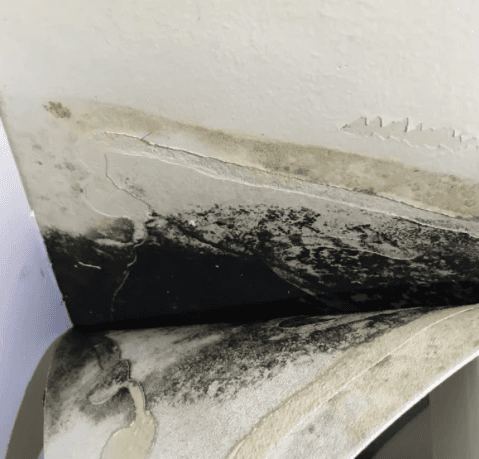
Mold Inspection
Root cause investigation, not just sampling
Mold Inspection in Salt Lake County, Utah
Mold concerns rarely come with certainty.
You might notice an odor that won't go away. A history of water damage that was never properly evaluated. Symptoms that improve when you leave the house and return when you come back. Or a vague sense that something is off — and no clear answer on what to do about it.
A mold inspection exists to answer one question: what is actually happening in this building, and why?
At Utah Mold Pros, every inspection is performed by Devon Kennedy — a Certified Indoor Environmentalist (ACAC-CIE) with a background in microbiology and building science. The process is physical, methodical, and focused on source identification. Not just sampling. Not just a visual pass.
We do not perform remediation. That separation is structural, not cosmetic. It means our findings reflect what's in the building — not what would generate the most downstream work.
What a Mold Inspection Is — and What It Isn't
A mold inspection is a physical evaluation of the building.
It focuses on how moisture enters the home, where it accumulates, and how it interacts with building materials over time. It's a structured investigation — starting with the areas most likely to harbor moisture and working systematically through the building.
That's different from mold testing, which uses air or surface samples to characterize what's present in the environment. Testing answers "what is here." Inspection answers "why is it here and where is it coming from."
Both have their place. But an inspection without physical investigation isn't an inspection — it's a sample with a fee attached.
If you're looking for mold testing specifically, that's a separate service →
What the Inspection Process Looks Like
Visual and physical assessment. Every area of the home with potential for moisture accumulation is evaluated — crawlspace, basement, attic, bathrooms, kitchen, areas around windows, and anywhere with a known or suspected water history. Hidden spaces are investigated, not skipped.
Moisture mapping. Professional moisture meters measure water content within building materials — drywall, framing, subflooring, concrete. Elevated readings identify problem areas before they become visibly damaged.
Thermal imaging. Infrared cameras detect temperature differentials in walls, ceilings, and floors that indicate hidden moisture or insulation failure. It's one of the most effective tools for finding what can't be seen on the surface.
HVAC evaluation. The air handler, ductwork, and drain pans are common mold reservoirs most homeowners never think about. Mold growing inside an HVAC system gets distributed to every room, every time the system runs.
Source identification. The inspection doesn't end at finding moisture. It traces the source — whether that's a plumbing failure, exterior intrusion, ventilation deficiency, condensation pattern, or something else. Understanding the source is what makes the findings actionable.
Written report. Following the inspection, you receive a detailed report with photos, moisture readings, observations, and clear recommendations. What was found, where, what's driving it, and what — if anything — needs to happen next. Not a table of numbers without context.
When to Schedule a Mold Inspection
History of water intrusion. A past pipe leak, roof failure, basement flood, or any moisture event that wasn't dried out completely within 24–48 hours warrants evaluation. Mold can establish quickly and persist long after the visible moisture is gone.
Persistent odors. A recurring musty smell — especially in basements, crawlspaces, or when the HVAC runs — often indicates active microbial growth before it becomes visible.
Before buying a home. A standard home inspection is not a mold inspection. Home inspectors are generalists. If the home has a basement, crawlspace, or any disclosed water history, an independent mold inspection before closing is a straightforward way to protect a significant investment.
Ongoing health symptoms. A mold inspection doesn't diagnose medical conditions. But if occupants are experiencing unexplained congestion, fatigue, headaches, or brain fog that improve away from home, evaluating the indoor environment is a logical step — particularly in cases involving CIRS, PANS, or PANDAS.
Post-remediation verification. If mold work has already been performed on the home, clearance should be confirmed by an independent inspector — not the company that did the remediation. See clearance testing →
Why Salt Lake County Homes Are Particularly Susceptible
The assumption is that Utah's dry climate keeps mold in check.
For parts of the state, that's partially true. But Salt Lake County sits in a valley. It has significant snowmelt and spring runoff. It has aging housing stock in neighborhoods like Sugar House, Millcreek, and Rose Park that wasn't built with modern moisture management in mind. It has basements — a lot of them — that are subject to subtle, ongoing moisture intrusion that goes undetected for years.
Seasonal temperature swings produce condensation inside wall assemblies and around windows. Rapid new construction in areas like Lehi and South Jordan compresses drying time. HVAC systems in older homes accumulate condensation that never fully clears.
Mold in Utah homes is often hidden. A surface-level walkthrough misses it. A building-science evaluation doesn't.
Why Independence Matters
When the company inspecting your home also sells remediation, their financial interest and your interest aren't aligned.
They profit when they find something significant. They go home with a smaller check when they don't. That structure — not individual dishonesty — is what produces inflated findings, unnecessary testing, and remediation scopes that go well beyond what the building actually requires.
Utah Mold Pros does not remediate. We have no remediation partners. We have no financial relationship with any work that follows our assessment.
Our only product is an accurate evaluation of your home. If the building is fine, we'll tell you it's fine. If it isn't, we'll tell you exactly what's happening and why.
About Utah Mold Pros
Utah Mold Pros provides independent, certified mold inspections throughout Salt Lake County and Northern Utah. Every assessment is performed by Devon Kennedy, a Certified Indoor Environmentalist through the American Council for Accredited Certification (ACAC).
Devon holds a BSc in Microbiology and an MBA, and brings both the scientific grounding and the practical building-science knowledge to assessments that most inspectors lack. His work is grounded in moisture diagnostics, indoor environmental quality, and a straightforward commitment to accuracy.
Utah Mold Pros does not perform remediation — ensuring that every finding and every recommendation is based solely on what the building contains, with no financial stake in the outcome.
Schedule a Mold Inspection in Salt Lake County
If something feels off about your home's environment, the right move is a clear answer — not guesswork, not a free inspection from a company that profits from what it finds.
Call or text (385) 775-2219 to schedule or ask questions. Free consultations available.
ACAC Certified. Independent. No remediation. No conflicts. Just answers.